Swing with Blog Marketing: 16 Website Content Ideas for B2B Leaders
It’s easy to get caught in the short-term trap: chasing ads, social engagement, and bottom-of-the-funnel leads. These moves offer the comfort of instant revenue & data, but they often lead to a lack of long-term leverage.
While ads can buy traffic and sales teams may pick up decent leads once in a while, it is ultimately a ‘wheel-spinning’ strategy—especially for B2B companies with long sales cycles.
When you stop paying for the ads & sales stop calling, the leads stop coming. To build long-term leverage & momentum, it helps to transition from simply renting attention to looking to own thought authority through Blog Marketing.
Here’s offering you 16 different website content ideas to drive mindshare & traffic, by engaging different approaches.
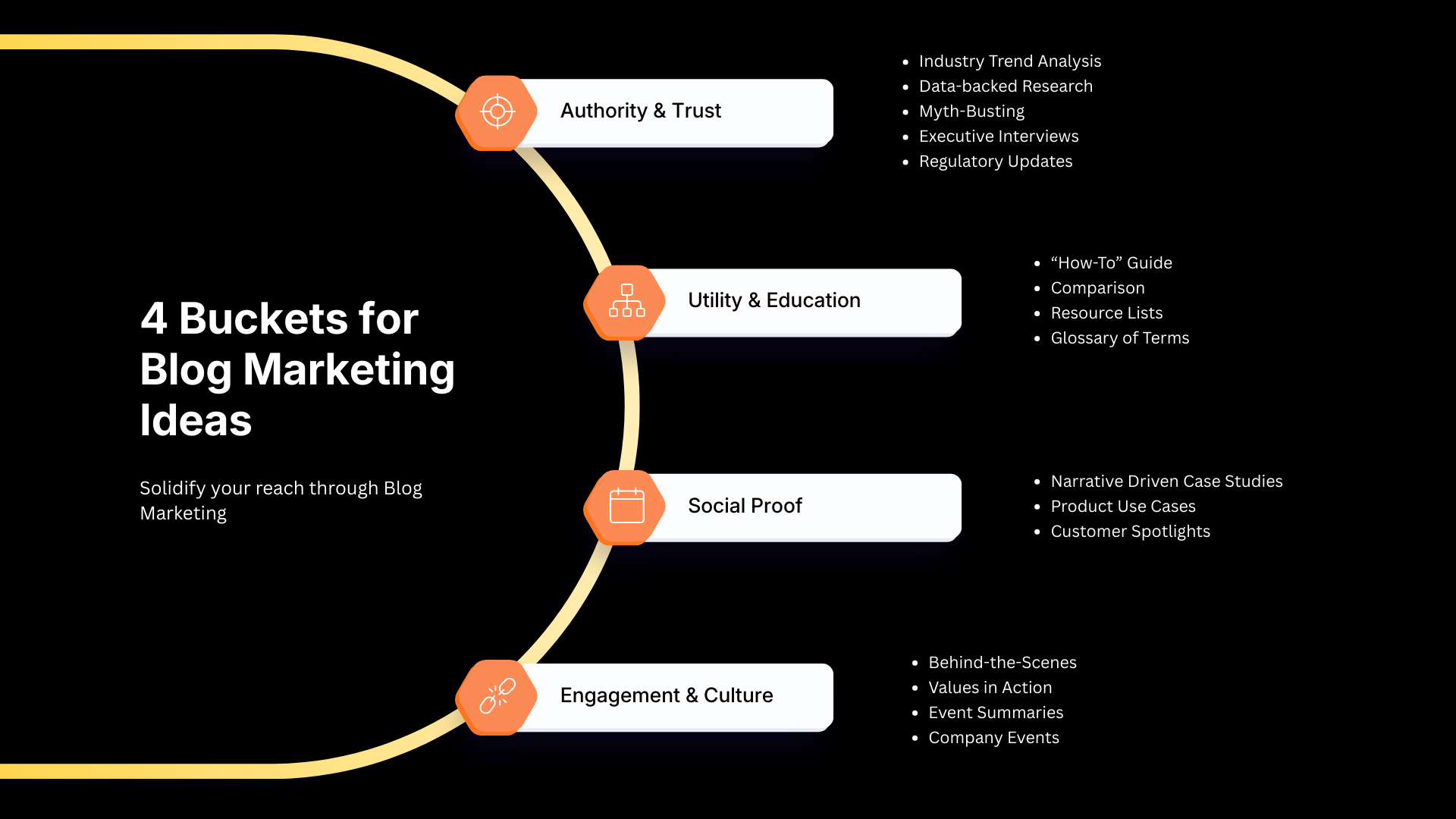
Forging Authority & Trust
1. Industry Trend Analysis:
Trend analysis write-ups are a powerful way to showcase the high-level thinking expected of market leaders.
It signals to your prospects that when they work with you, they are partnering with an organization that possesses a deep understanding of where the world is moving.
For example, if you’re a HR placement firm, you might have an article such as: Understanding Regional Hiring Trends: Tapping into Southeast-Asian Markets.
2. Data-backed Research:
Solid data is always interesting and exciting to a B2B audience.
With these types of website content ideas, you “pull back the covers” by sharing surveys or internal data findings, offering the reader an objective, bird’s-eye view of the industry.
This type of content is a powerful driver of long-term leverage because it’s very shareable, leading to other industry blogs & news outlets to link to you.
It also builds trust with prospects. It moves the conversation from “We think this works” to “The data proves this works.”
3. Myth-Busting:
As an outsider to an industry or even a seasoned veteran, there will always be certain myths or “common wisdom” that people follow blindly, whether they are true or not.
One way to generate incredibly eye-catching content is to use blog writing to shed light on these items and challenge the status quo.
By debunking a popular industry myth, you’re not just being provocative; you’re demonstrating a deeper level of expertise.
EB Food’s post about frozen food myths : Myths about frozen food you should stop believing
4. Executive Interviews:
Executive interviews are a great way to show the minds behind the organization.
In the often impersonal world of B2B, this content plan helps by personifying the business. You show potential customers exactly what the company stands for & what leadership believes in achieving for their clients.
This builds a deeper layer of trust because it connects on a human level, showing customers that your organization is made of passionate experts dedicated to their success.
5. Regulatory Updates:
There is a powerful Blog Marketing strategy where companies churn out articles in line with the latest trends and happenings as part of their content plan.
One of the most effective ways to capture these spikes in interest is by providing timely regulatory updates to your readers.
During specific times of the year or following major government announcements, certain legal or policy topics become exceptionally popular in search.
An example of this in the consumer space is BTO launches. In the lead-up to a launch, there is a massive surge in search volume, and you will see a flurry of articles comparing the available projects.
In the B2B world, the principle is the same: when a new regulation or policy is announced, your prospects are looking for someone to help them make sense of the noise.
By Utility & Education
1. The “How-To” Guide:
Even in the age of AI search, “How-To” guides remain essential. While AI can provide quick definitions, it often lacks the depth required for complex, high-stakes B2B topics.
It might not be sufficiently able to answer to the level of triage needed to actually resolve a multi-layered problem.
Blog writing from expert-led guides provide the context, safety warnings, and logic that an algorithm can’t replicate.
By creating these with much details, you own the long-term leverage of being the digital “Instruction Manual” for your industry.
2. Comparison:
If you are bringing an new solution to the market, a comparison-style article is one of your most potent tools in your content plan.
Customers are often hesitant to abandon traditional methods because they’re familiar with how the old methods work, even if they’re not as ideal.
By contrasting your innovative approach against legacy systems, you help the reader visualize the transition & be comfortable with it.
3. Resource Lists:
Have you ever felt so busy that you couldn’t find the time to look for a new solution to a pressing issue? This is a common pain point for B2B stakeholders.
Now, imagine if someone handed you a comprehensive guidebook filled with a multitude of possible solutions that you could implement immediately.
By creating a “Resource Directory” or a “Tech Guide” content plan, you offer value & do the heavy lifting for your prospect.
4. Glossary of Terms:
It may seem unorthodox, but for complex industries, there are always readers searching for a specific term they might have forgotten or mistaken.
Whether it’s a new acronym or a technical process, a Glossary of Terms serves as a vital anchor for your content strategy.
For inspiration: Mailchimp’s marketing glossary
Gartnering Social Proof
1. Narrative Driven Case Studies:
Narrative-driven case studies elevate your brand in so many ways. Beyond a simple review or a list of bulleted results, a narrative represents a successful transformation of the client’s needs.
By sharing about the obstacles faced, the pivot points, and the project completion, you help potential customer understand better how your organization can help them meet their goals
It also builds emotional resonance – Readers remember stories far longer than they remember statistics.
2. Product Use Cases:
Sometimes, a prospect understands what your product is, but they can’t quite visualize how it fits into their specific daily routine.
Bridge this gap with product use case articles; highlight specific scenarios where your solution fits well & performs at its best.
As with all solutions, the reader may have doubts on edge cases which your product could be used; this also helps to clear any doubts on those.
3. Customer Spotlights:
A Customer Spotlight moves the focus away from your product features and shines it directly on the people who use them.
It represents a shift from showing what you did, to instead showing the amazing people you helped.
By celebrating your customers’ professional achievements and sharing their stories, you create a powerful sense of community
Check out Acer’s customer spotlight stories as reference : Acer’s TravelMate P6 14 AI Successes
Engagement & Culture
1. Behind-the-Scenes:
Sometimes, blog marketing doesn’t always need to be serious and business-like. Have you ever tried doing a pivot to something more day-to-day?
Using seemingly trivial stuff—like the day-to-day job, the office environment, or how your team collaborates, you’re able to show a more human-like side to your audience.
In a world where B2B marketing can often feel cold or overly processed, showing the inner workings proves that there are real, passionate people behind the emails and the deliverables.
2. Values in Action:
Instead of just talking about your values, try showing it through your content & narrative.
For example, if your mission is about delivering food products that are safe, nutritious and affordable, craft a piece of content sharing the effort & direction your team took to get the end-result.
This proves that your values are active filters for how you make decisions, not just pretty words on a wall.
3. Event Summaries:
Industry conferences and exhibitions frequently come and go, yet few companies really bother to tap on the publicity generated by these events to extend their content reach.
When your team attends a major event, you’re sitting on a wealth of insights that your audience can be searching for.
When you publish an event summary, you turn a fleeting moment into a permanent asset. You filter out the most important takeaways for your clients who couldn’t attend.
Hardwarezone’s post as reference : 2025 Smart Home Tech Show
4. Company Events:
Do you have any upcoming company events, such as a sales kick-off, a team-building retreat, or a charity initiative? Such events are a great way to build bonds with your audience.
Sharing these moments allows your followers to celebrate your growth and witness the culture you’ve built from the inside out.
Apart from having the benefit of being easy to write, documenting these milestones also builds up your social capital, helping to invite your audience into the community.
Full Spectrum Blog Marketing
By driving with content alongside sales and socials, organizations can build a more holistic approach to marketing and demand generation.
Furthermore, a solid content strategy helps build your long-term leverage. Unlike short-term ad campaigns, high-value articles allows you to constantly develop the pool of your top-funnel prospects.
Effectively nurturing readers today, building familiarity tomorrow, and setting the stage for future conversions later on.
Summary
Yes. It remains the most cost-effective way to educate your market, solve prospect doubts at scale, and build long-term SEO/AEO authority that you own, rather than rent.
Consistency beats quantity. While there is no “magic number,” most organizations see a “compounding effect” after 20 to 30 high-quality pieces. Also remember to test different content types to see which one works best for your organization.
Measure success through Impressions (No of times your article was highlighted during search), Engagement (time spent on page), Authority growth (ranking for key industry terms). A good tool for this would be Google Analytics. Connect it to your website to support your blog marketing efforts
dantiv can help. We are a digital agency well-versed in web development, Martech, and content strategy for SEO & AEO (Answer Engine Optimization). We specialize in supporting SMEs in Singapore in Blog Marketing & on their quest to be found online.