Best Restaurant Website Strategies for Local SEO & Search Performance

In the hyper-competitive restaurant industry, simply relying on social media marketing and word-of-mouth may not be enough to fill your seats. Today’s diners start their search online; whether that’s social media, reviews, or for some niches, direct search engine queries.
This guide breaks down what actually moves the needle for restaurant local SEO; from the content and keywords you choose, to the page experience once someone lands, to the technical foundations that let search engines find and trust your site in the first place.
Today’s diners start their search online; whether that’s social media, reviews, or for some niches, direct search engine queries.
How the Restaurant Search Engine Optimization Game Is Played
Winning at local search performance requires looking at SEO as an interconnected system rather than a single trick. Success depends on aligning technical health, user experience, content relevance, and machine readability.
Here is a rough overview of the 7 main pillars that should serve you well as a guide for starting your restaurant SEO venture right.
SEO Article Planning & Keyword Research
Before writing a single word, you must define your niche and understand what your ideal diners are typing into Google. Keyword research reveals search intent, helping you plan and build content around real queries, traffic volumes, and local interests.
Local SEO for Restaurants
Google’s algorithm shows different results to searchers based on a range of factors such as location, preferences, and search history. Local SEO helps you capture searches in your area that are pertinent to your restaurant.
Google Business Profile
Your Google Business Profile is often the first thing a potential diner sees, especially in the local map pack. Setting it up correctly and keeping it active is one of the highest-leverage things you can do for local visibility.
Improving CTR and Engaging Page Design
Ranking on page one means little if searchers don’t click your link, and even worse if they bounce seconds after landing. High click-through rates (CTR) combined with strong page engagement signal to search engines that your site provides genuine value, which in turn supports your broader SEO efforts.
Page Crawlability & Server Limitations
None of your content matters if search engines can’t crawl and index it. This section covers the technical checks that keep your site visible and accessible.
SEO Management & Analytics
SEO isn’t a set-and-forget task. By doing ongoing measurement, you ensure what you’ve done actually contributes and understand what’s working, what’s not, and where to focus next.
Structured Data for Social Media & Local SEO
Structured data helps search engines understand your business beyond just what’s on your page. You should connect your site to your location, menu, reviews, and social presence.
SEO Article Planning & Keyword Research

Every successful restaurant SEO campaign starts with your restaurant’s identity. Are you a high-end steakhouse catering to date nights, a lively hotpot spot for groups, or a no-frills, all-you-can-eat weekend buffet?
Defining your niche allows you to map out your Ideal Customer Profile (ICP) and work on the exact search terms they use. Free tools like Google Keyword Planner and Google Trends are ideal for identifying local search demand.
Pro Tip: When launching a new site or refreshing your content, start by targeting low-competition, long-tail keywords (e.g., “best group hotpot with private rooms” instead of just “hotpot restaurant”). This helps you build domain authority faster.
Plan your content around topic clustering: create a core page around your primary concept (e.g., authentic Mexican food) and link supporting blog posts or sub-pages to it (e.g., “Types of Mexican Dishes for Sharing,” “Halal Mexican Food in SG”).
Finally, test compelling titles and meta descriptions with strong calls-to-action (CTAs) to entice users to click over your competitors.
In short:
- Define your niche and Ideal Customer Profile before writing anything
- Use Google Keyword Planner and Google Trends to find real local search demand
- Target low-competition, long-tail keywords early to build domain authority
- Cluster content around core topics with supporting sub-pages
- Test titles and meta descriptions with strong CTAs to win the click
Local SEO for Restaurants
Because of the nature of F&B, local SEO plays an outsized role in generating digital awareness for your restaurant. Google’s algorithm tends to prioritize showing your website when the searcher is physically near your restaurant, or when they’re searching for a spot in your area.
The interesting thing is that you don’t necessarily need to open a restaurant in that area, but you do need to give Google a reason to associate your restaurant with that area. Ideas include location-specific content, directory listings, or being mentioned by food bloggers.
There are three main levers you can pull to optimize your restaurant’s local SEO: page crawlability, your Google Business Profile, and structured data.
1. Page Crawlability
Make sure your restaurant location and address are in crawlable text on multiple locations on your website. Google’s algo needs to know this in order to match your restaurant to the right queries. Do submit your sitemap through Google Search Console to help it get indexed.
2. Google Business Profile
Your Google Business Profile (GBP) is often the first thing a potential diner sees, especially in the map pack that shows up above regular search results. Keep your profile complete and accurate: correct opening hours, menu, photos, and categories all matter. More details in the section below.
3. Structured Data
Structured data (schema markup) helps Google understand exactly what your page is about. You can also link social media entities to your restaurant for Google to display them as related to each other. See the segment on this below.
Apart from the three main levers above, you may also consider:
- Optimizing social media posts with relevant keywords and descriptions.
- Getting food bloggers to list your restaurant as serving that area.
- Running PR campaigns to build local mentions and backlinks.
Local SEO for restaurants does take quite a bit of effort, but can reap outsized returns, and return visits too.
Google Business Profile
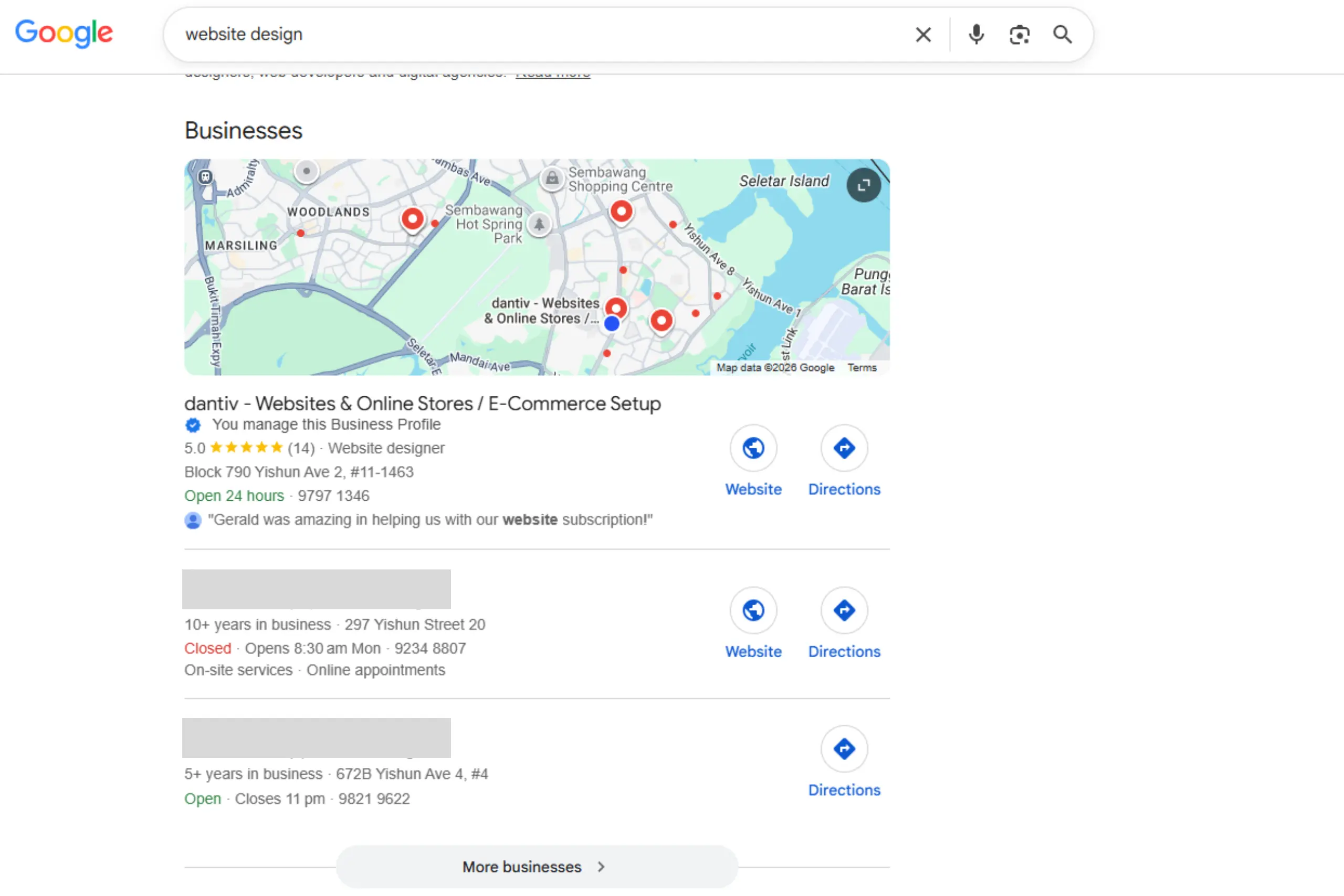
Your Google Business Profile is important for SEO because you need it to show up in the local map pack. That’s a snippet showing the top 3 options that appear when someone searches for a restaurant nearby. Example as shown above.
The local map pack is particularly useful because it tends to show up near the very top of a search results page, and due to the way it’s displayed, it provides a very high click-through and conversion rate for restaurants listed in it.
Furthermore, when your local map pack listing is combined with high reviews and a well-crafted website, your odds of converting a searcher into a reservation or booking go up significantly.
Assuming you’ve set it up, the four main ways of optimizing your Google Business Profile include:
1. Fill Out Your Google Business Profile Completely
Make sure your profile includes accurate services, contact details, products, menu, and working hours. This helps Google use this information to match your restaurant to relevant searches.
2. Collect and Reply to Reviews
Reviews are one of the strongest trust signals for both diners and Google’s algorithm. Actively encourage happy customers to leave reviews, and make it a habit to reply to them.
3. Use Keywords in Your Profile Name
Where appropriate, include relevant keywords (like your cuisine type or specialties) in your business name on your profile. This can help your restaurant surface for more specific, relevant searches, though it should still reflect your actual business name to stay within Google’s guidelines.
4. Link Your Website to Your Profile with Structured Data
Connecting your website to your Google Business Profile using structured data helps Google confirm that both sources are talking about the same restaurant, strengthening your overall local SEO signals.
In our experience, optimizing your Google Business Profile is like a shortcut to getting visibility and leads, so remember to work on it.
Improving CTR and Engaging Page Design
Appearing in search results is only half the story. Once someone clicks through, you need to give them a reason to stay.
That means thoughtful page design: a layout that’s easy to scan, compelling snippets that pull readers further down the page, and internal links placed naturally at the points where a reader is likely to want to know more; like linking to your menu page right after describing a signature dish.
High-quality, appetizing imagery does a lot of heavy lifting for a restaurant site. Use it generously, and bring in animations where they add polish rather than distraction.
Remember to review the flow of information: make sure each section actually delivers on what its heading promises, and break up long blocks of text so the page feels easy to read rather than overwhelming on both desktop and mobile.
Summarized:
- A clean, scannable layout with strong snippets keeps readers moving down the page
- Place internal links naturally where a reader would genuinely want to know more
- Use high-quality imagery and purposeful animations to keep the page engaging
- Break up long text blocks and ensure each section delivers on its heading

Looking to get some help? At dantiv, we are the leading SEO agency in Singapore for restaurants & SMEs.
Page Crawlability & Server Limitations

Search engines use automated web crawlers to discover, parse, and index pages. If your technical architecture is poor, your content stays invisible regardless of quality.
1. Consistent Local NAP Data
For local SEO, your Name, Address, and Phone Number (NAP) must be clear, consistent, and easily crawlable across your entire website (typically in the global footer). This helps search engines pinpoint your location and details for sharing with the public.
2. On-Page Technical Standards
- Heading Structure: Maintain a strict, logical hierarchy; only one H1 tag per page (typically the main title), followed sequentially by H2s and H3s.
- Clean Code: Avoid excessive, unoptimized JavaScript framework rendering that delays crawler indexing.
- Image Optimization: Add descriptive ALT text to all images (e.g.,
alt="dry-aged ribeye steak on wood board") to improve Google Image search rankings. - Auditing Tools: Periodically run automated audits using tools like Google Lighthouse, PageSpeed Insights, or Screaming Frog to spot technical errors early.
3. Server Health Sanity Check
An outdated or underpowered web host can bottleneck load speed and throw server errors when crawlers index your site heavily. Ensure your hosting infrastructure can handle traffic spikes seamlessly.
SEO Management & Analytics
Publishing your content is just the beginning. To consistently improve search rankings, you need to track performance and refine your approach over time.
1. Verify Indexation
Never assume a published page is indexed automatically. Use Google Search Console (GSC) to submit your XML sitemap, or use the URL Inspection Tool to manually request indexing for new or refreshed pages.
2. Analyze Traffic with Google Analytics (GA4)
Track key metrics like traffic sources, user drop-off points, average session duration, and overall engagement rates for your posts.
3. Leverage Heatmaps
Deploy behavior-tracking tools like Hotjar or Microsoft Clarity. Heatmaps show where visitors click, how far down the menu page they scroll, and where they lose interest, providing clear visual data for your next effort.
Never assume a published page is indexed automatically.
Structured Data for Social Media & Local SEO
Structured data schemas let you formally connect your website to your other digital profiles such as Google Maps, Facebook, Instagram, and TikTok.
This positions your restaurant as a consistent, trustworthy entity that’s active and verifiable across the platforms your customers tend to use.
This matters because it helps search algorithms pull and present the right information to the right searchers, whether that’s your hours, your menu, your reviews, or a link straight to your latest social content.
This makes your business easier to find and also easier to trust at every touchpoint.
So far:
- Use structured data to formally link your website to Google Maps, Facebook, Instagram, and TikTok
- Add structured data for key business details; location, menu items, reviews, and specializations, so search engines can pull and display them directly
Wrapping It Up
There’s no shortcut for local SEO for restaurants; it’s about getting the fundamentals right across content, page experience, crawlability, analytics, and structured data, then refining as you go.
Get these pieces working together, and you stop competing solely on word of mouth and start showing up right when potential customers are searching for exactly what you offer.

Looking to get some help? At dantiv, we are the leading SEO agency in Singapore for restaurants & SMEs.